
Shin Splints Physical Therapy for Runners: Causes, Warning Signs, and Recovery Tips
Shin splints physical therapy is about more than treating pain along the front or inside of the lower leg. For runners, shin pain is often a sign that the body is struggling to tolerate the current amount of impact, mileage, intensity, terrain, or training frequency. The pain may show up during the first mile, after speed work, on hills, after increasing weekly mileage, or even the morning after a run.
If you are a runner, you may already know the feeling. A dull ache along the shin. A pulling or burning sensation near the inside of the lower leg. Tenderness when you press along the bone. Pain that warms up during a run, only to return later. Recognizing these early signs can help you feel more in control and prevent the issue from worsening.
That is the point where it deserves attention.
What Are Shin Splints?
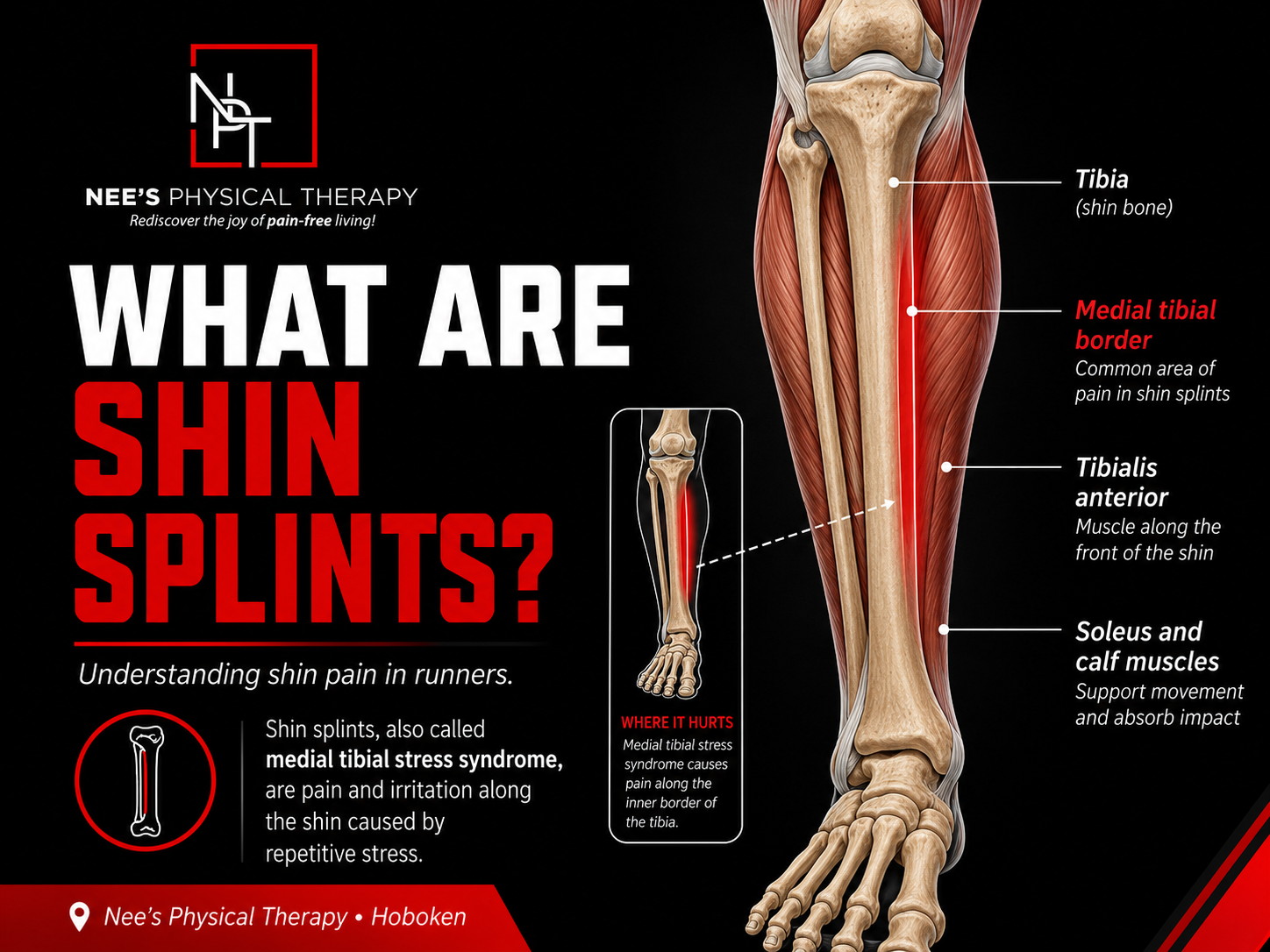
“Shin splints” is the common term runners use for pain along the shin bone. Clinically, many cases are referred to as medial tibial stress syndrome, especially when the pain is felt along the inner border of the tibia.
This condition is often linked to repeated stress in the lower leg. Running creates impact. That impact has to be absorbed and controlled by the muscles of the foot, ankle, calf, shin, knee, hip, and trunk. When the amount of stress exceeds what the tissues can currently tolerate, irritation can build along the shin.
This does not mean running is bad. It means your body may need better support, better recovery, a smarter training plan, or more strength to handle the demands you are placing on it.
Shin splints are common in runners because running is repetitive. Every mile includes hundreds of foot strikes. A small issue in load, strength, cadence, mobility, or mechanics can become a bigger issue when repeated over time.
Why Shin Pain Happens During Running
Shin pain running can happen for several reasons, and it is rarely just one thing. The most common pattern is a mismatch between training demand and tissue capacity.
In simple terms: your running increased faster than your body was ready for.
This may happen when you:
Increase mileage too quickly
Add speed work or hill running suddenly
Return to running after time off
Switch surfaces, such as a treadmill to pavement
Start training for a race without enough recovery
Run more days per week than usual
Change shoes or run in worn-out shoes
Add strength training without adjusting the running load
Ignore early soreness until it becomes pain
The shin muscles help control the foot and ankle when you land. The calf muscles help absorb and push off. The bones and surrounding tissues adapt to load, but they need time. If the loading increases faster than the body can adapt, symptoms may appear.
That is why rest alone often does not solve the problem in full. Rest may temporarily calm symptoms, but if the same training pattern, strength gap, or movement issue persists, the pain may return when running resumes.
A Runner Scenario: When “Just a Little Shin Pain” Becomes a Pattern
Imagine a runner training for a spring race. She has been consistent for a few weeks and feels good, so she adds an extra run day. Then she adds intervals. Then she joins a longer weekend run with friends. The first sign is a mild ache along the inner shin during the first mile.
She stretches her calves, keeps running, and the pain warms up. A few days later, the ache comes back sooner. Then it lingers after the run. Eventually, the stairs feel uncomfortable and the pressure along the shin feels tender.
This is a common runner pattern. The pain did not appear randomly. It was built as the body’s tolerance was exceeded.
A running injury PT would not only ask, “Where does it hurt?” They would ask what changed. Mileage, pace, hills, surface, footwear, recovery, strength work, sleep, and recent training patterns all matter.
Warning Signs Runners Should Not Ignore
Not every ache means you need to stop running completely. But some signs suggest that the shin is becoming more irritated and needs attention. Recognizing these warning signs can empower you to take timely action and avoid more serious injury.
Pay attention to:
Pain starts earlier in each run
Pain continues after running
Pain changes your stride
The shin is tender to touch
Pain is present while walking
The pain, being sharp or localized to one spot, is a warning sign that should not be ignored, as it may indicate a developing stress injury requiring prompt attention.
Symptoms are worsening week by week
You feel pain even after rest days
You are relying on stretching, tape, or pain relievers to keep running
A broad, achy discomfort along the shin may behave differently than a sharp, focal pain on the bone. A sharp, specific, worsening pain should be taken seriously because runners can also develop bone stress injuries. If pain is intense, localized, worsening, or present with walking, it is best to get evaluated.
The goal is not to scare you. The goal is to help you act before the injury becomes more limiting.
What Physical Therapy Looks at Beyond the Shin
Physical therapy for shin splints involves more than treating pain; it assesses foot, ankle, and hip function, as well as training factors, to identify root causes and prevent recurrence.
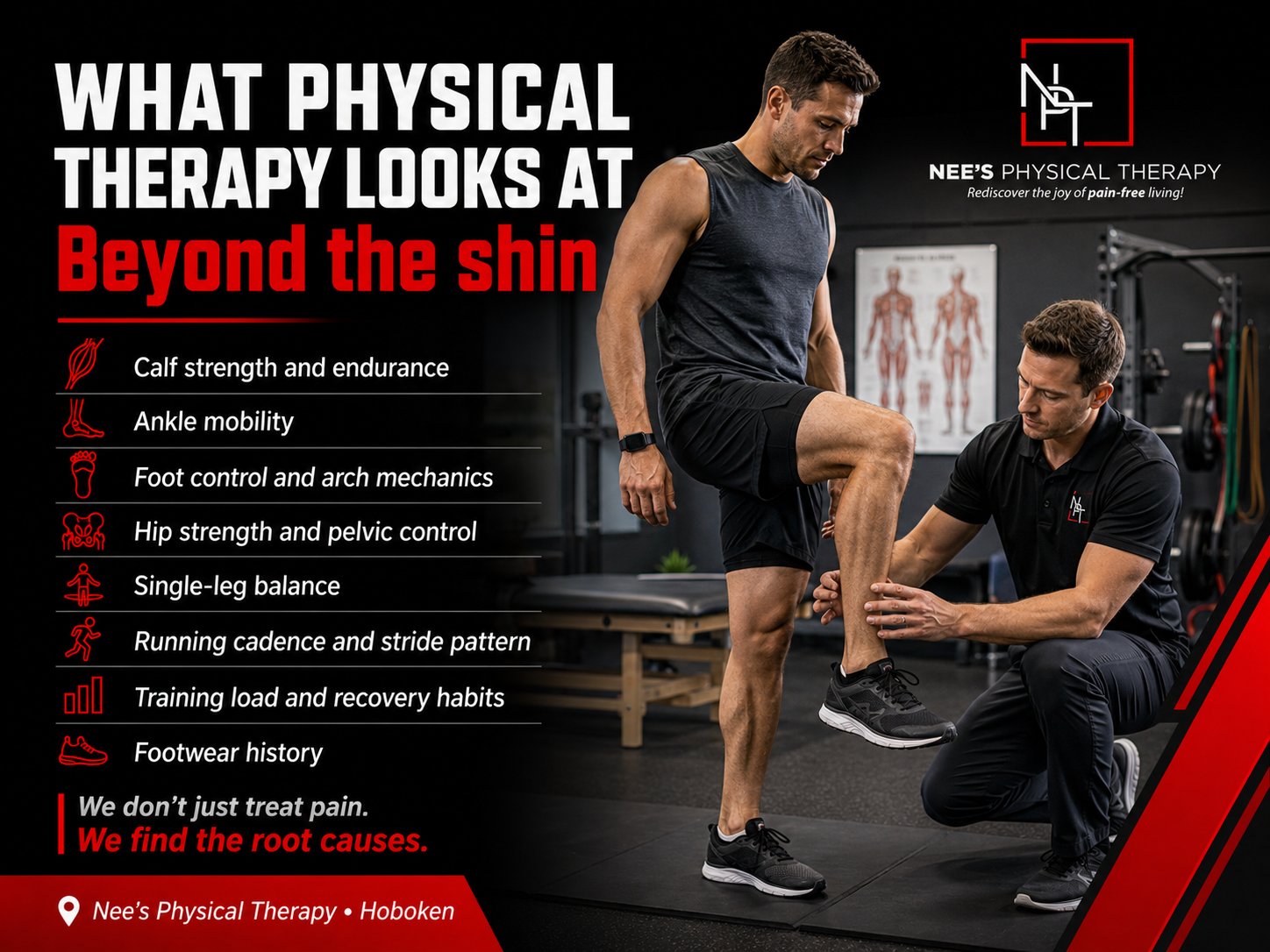
A thorough assessment may look at:
Calf strength and endurance
Ankle mobility
Foot control and arch mechanics
Hip strength and pelvic control
Single-leg balance
Running cadence
Stride pattern
Training load
Recovery habits
Footwear history
Pain behavior during and after running
For runners, this matters because the shin does not absorb impact on its own. If the calf is not strong enough, the shin may take more stress. If the hip is not controlling the leg well, the lower leg may compensate. If the ankle is stiff, landing mechanics may change. If the mileage increases too fast, even good mechanics may not be enough.
This is where Sports PT can be helpful. It connects the symptom to the full running system.
Can Physical Therapy Help Shin Splints and Keep Runners Active?
Yes, physical therapy can often help runners manage shin splints while staying as active as possible, but the plan depends on the severity of symptoms. The goal is not always complete rest. The goal is the right level of load.
Some runners may need a short break from running. Others may be able to continue with modified mileage, reduced intensity, flatter routes, more recovery, or run-walk intervals. Some may need to temporarily pause impact and maintain fitness through biking, swimming, the elliptical, or strength training.
The key is knowing what your shin can tolerate right now.
A physical therapist can help determine whether running should be modified, reduced, or paused based on how symptoms behave during and after the run and the next day. This is more useful than guessing or following a generic online plan.
Training Load: The Piece Runners Often Miss
Training load is one of the biggest factors in shin splints. Runners often look for the perfect shoe, stretch, or exercise, but the bigger issue may be how quickly the body is asked to adapt.
A sudden jump in mileage, speed, hills, or frequency can overload the lower leg. Even a strong runner can develop shin pain if the progression is too aggressive.
A helpful training-load note: your body adapts to stress when the stress is introduced gradually and paired with enough recovery. Progress in running is not only about doing more. It is about doing more at the right pace.
If shin pain is showing up, your plan may need adjustments, such as:
Reducing weekly mileage temporarily
Avoiding speed work for a short period
Choosing flatter routes
Spacing out run days
Adding recovery days between impact sessions
Using run-walk intervals
Keeping easy runs truly easy
Building strength before increasing intensity again
The goal is to keep you moving without repeatedly irritating the same tissue.
Why Strength Training Matters for Shin Splints
Strength training is not just “extra” for runners. It helps improve the body’s ability to absorb and produce force.
For shin splints, strengthening may focus on the calves, tibialis anterior, foot muscles, glutes, hamstrings, quads, and core. A runner with shin pain may need improved calf capacity, hip control, or single-leg strength.
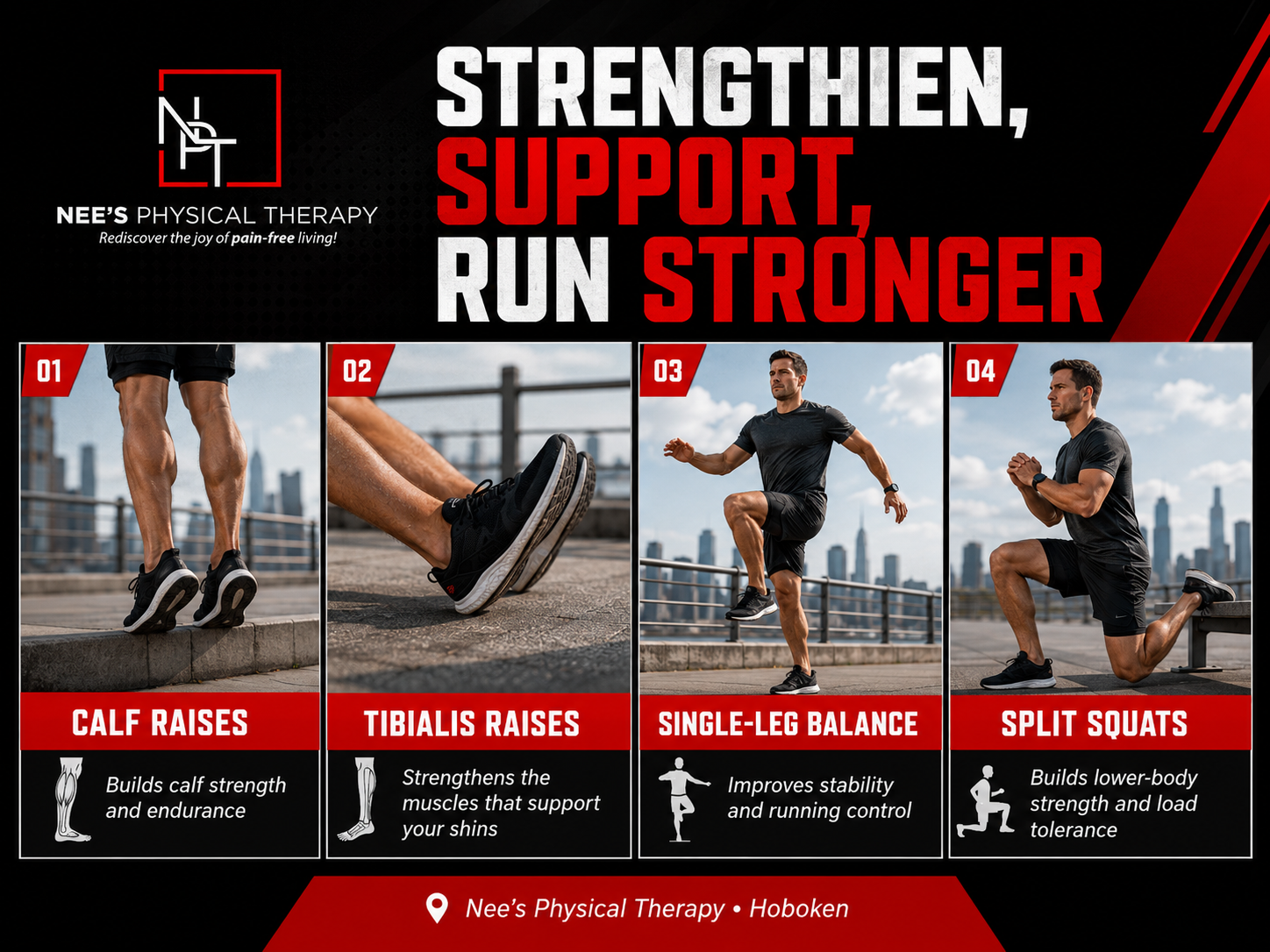
Examples of exercises that may be used in a PT plan include:
Calf raises
Bent-knee calf raises
Toe raises
Tibialis raises
Single-leg balance drills
Step-downs
Split squats
Glute bridges
Hip hikes
Lateral band walks
Running-specific plyometric progressions when appropriate
The right exercises depend on the assessment. A runner with weak calves may need a different plan from a runner whose main issue is hip control or training overload.
When Gait Analysis Can Help
A gait analysis can be useful when shin pain keeps returning, occurs only with running, or appears to be connected to stride mechanics. It can help identify patterns such as overstriding, low cadence, heavy landing, excessive vertical bounce, poor hip control, or asymmetry between sides.
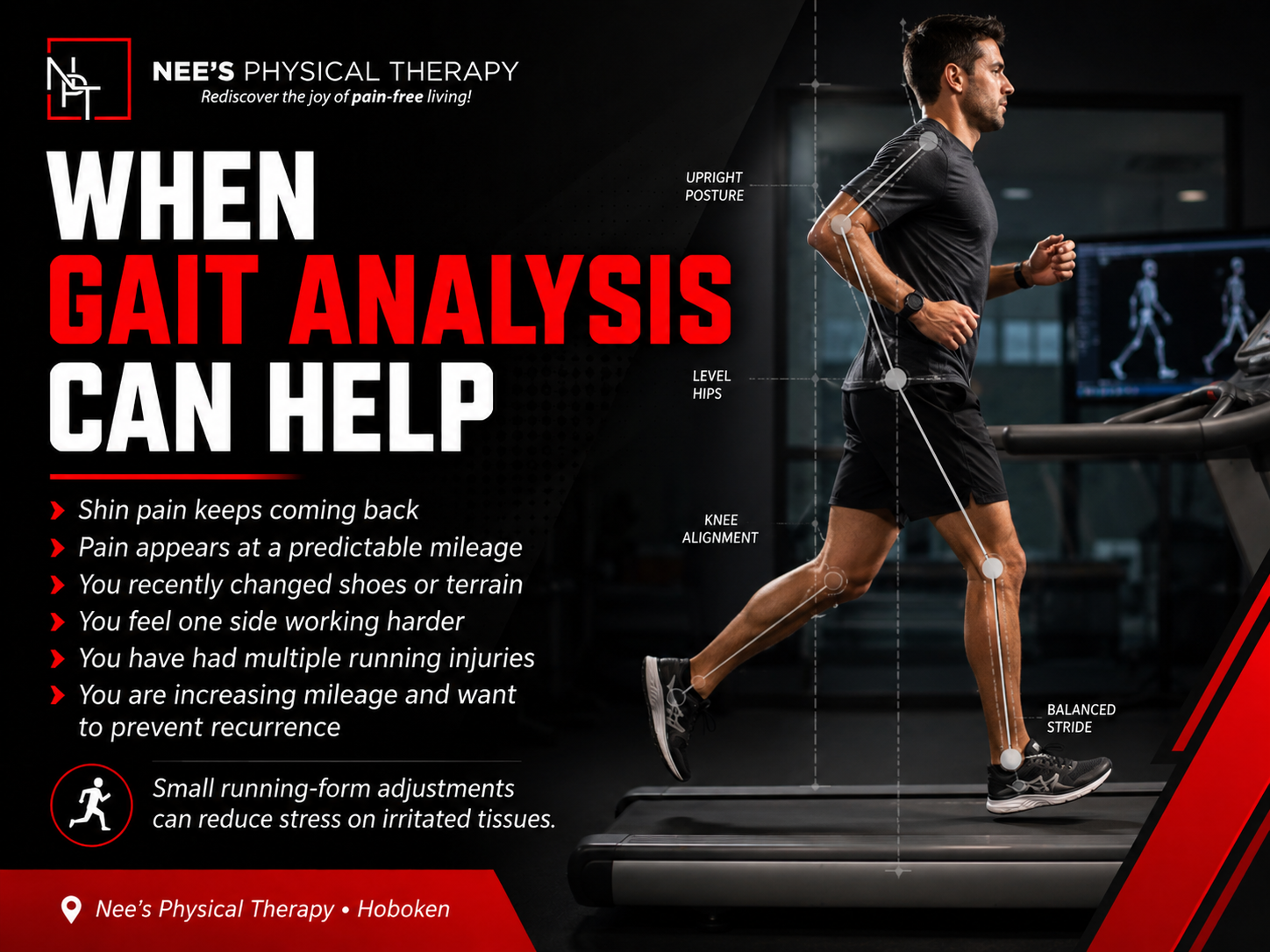
This does not mean every runner needs a dramatic change in form. In fact, changing too much too quickly can create new problems. But small adjustments, when appropriate, can reduce stress on irritated tissues.
A gait analysis may be especially helpful if:
Your shin pain keeps coming back
Pain appears at a predictable mileage
You are training for a race
You recently changed shoes or terrain
You feel one side working harder than the other
You have had multiple running injuries
You are increasing mileage and want to prevent recurrence
At Nee’s Physical Therapy in Hoboken, gait analysis may be used as part of a broader running injury PT assessment. The goal is not to criticize your running form. It is to understand how your body is handling the load and where support may be needed.
Recovery Tips for Runners With Shin Splints
Recovery from shin splints should be active, strategic, and based on symptoms. Simply pushing through can make the irritation worse. But stopping all activity without addressing the cause may not prevent it from returning.
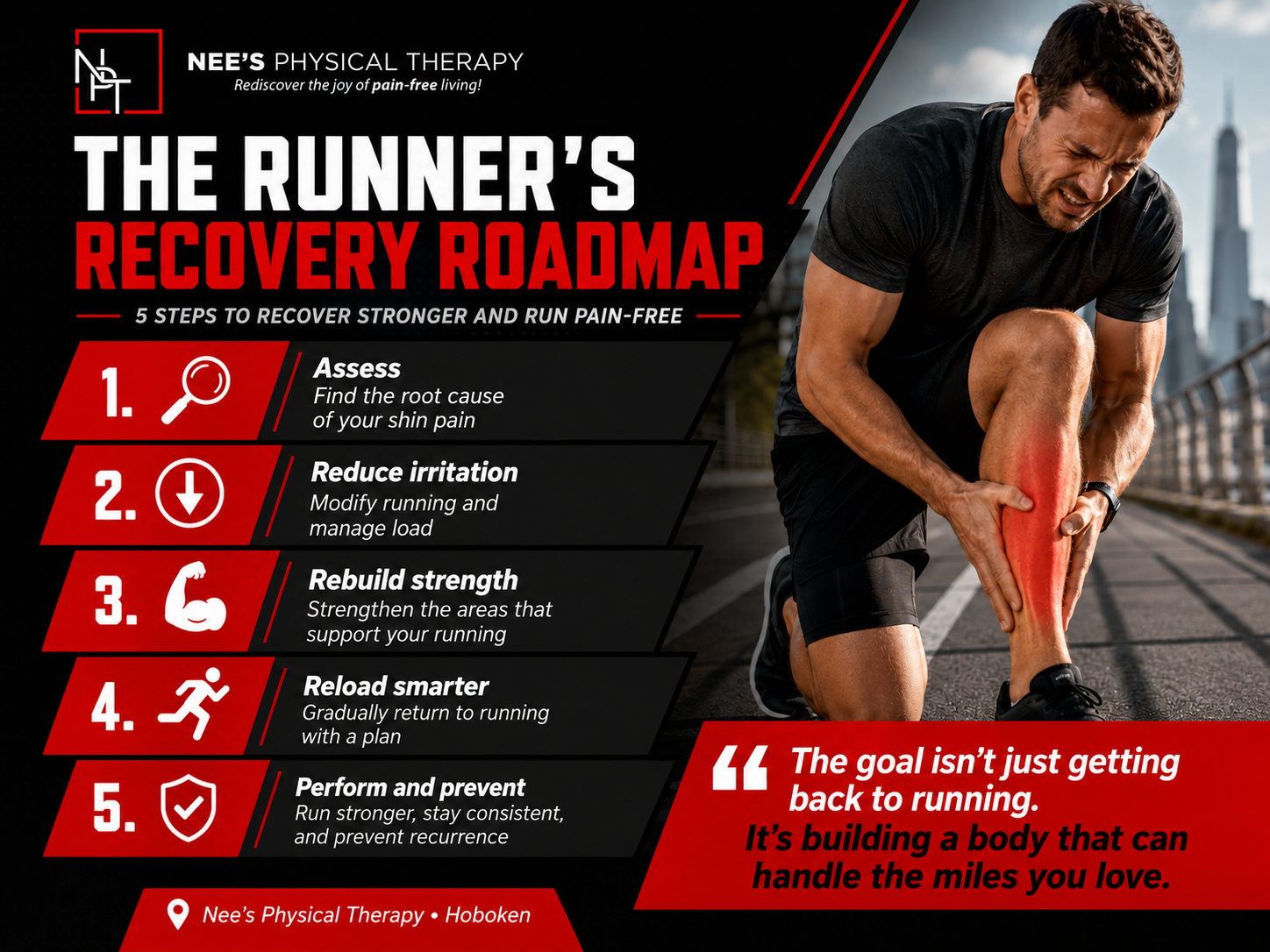
Here are practical recovery tips:
Reduce the impact temporarily if the pain is worsening
Avoid speed work, hills, and hard surfaces during flare-ups
Use cross-training to maintain fitness
Strengthen the calves, hips, and lower leg gradually
Do not increase mileage and intensity at the same time
Track symptoms during, after, and the next morning
Replace worn-out shoes if needed
Prioritize sleep, nutrition, and recovery days
Return to running gradually instead of jumping back in
A good return-to-running plan should feel boring at first. That is usually a good thing. The early goal is consistency without flare-ups.
How Nee’s Physical Therapy Approaches Shin Splints in Runners
At Nee’s Physical Therapy in Hoboken, runners are assessed with an orthopedic and Sports PT lens. Akanksha Rathod provides 1:1 care, which allows time to understand the full picture, including training load, running history, strength, mobility, gait, recovery, and the specific way symptoms show up.
For one runner, the main issue may be a sudden increase in mileage. For another, it may be calf weakness. For someone else, it may be hip control, running mechanics, poor recovery, or returning too quickly after a break.
The goal is not to hand every runner the same list of exercises. The goal is to identify what is limiting your body’s ability to tolerate running and build a plan around that.
“For runners, shin pain is often a load-management problem before it becomes a bigger injury. The earlier we identify what changed in training, strength, or mechanics, the easier it is to keep the runner active while protecting the tissue.” - Akanksha Rathod
When Should You See a Running Injury PT?
You should consider seeing a running-injury PT if shin pain is recurring, worsening, changing your stride, lasting after runs, or making you nervous about training. You should also get assessed if you are preparing for a race and symptoms are interfering with your plan.
It is especially important to seek care if pain becomes sharp, localized, painful with walking, or does not improve with reduced running. These signs may need further evaluation to rule out a more serious bone stress injury.
You do not have to wait until you can no longer run. In many cases, the best time to get help is when symptoms are still mild but becoming more frequent.
A Smarter Way to Recover From Shin Splints
Shin splints can be frustrating because the pain often starts small. Many runners ignore it at first, stretch the calves, change shoes, or take a few days off. Sometimes that helps temporarily. But if the underlying issue is training load, strength, mobility, or running mechanics, the pain may return when running resumes.
Shin splints physical therapy helps runners understand why their shins are irritated, what needs to change, and how to return to running with more confidence. The goal is not just to calm symptoms. The goal is to build a stronger, more resilient runner.
Medical disclaimer: This content is for educational purposes only and does not replace medical advice, diagnosis, or treatment. Shin pain can have different causes, including bone stress injuries. Please consult a qualified healthcare professional for guidance based on your individual symptoms.
FAQ
Can I keep running with this pain?
It depends on how the pain behaves. If the pain is mild, does not change your stride, does not worsen during the run, and settles quickly afterward, you may be able to continue with modifications. That may mean reducing mileage, avoiding speed work, choosing flatter routes, or using run-walk intervals.
If pain is worsening, sharp, localized, present while walking, or lingering after runs, you should stop running and get assessed. Pushing through those signs can make recovery more difficult.
What should I stop doing first?
The first things to reduce are usually speed work, hills, sudden increases in mileage, and back-to-back impact days. These create more stress through the shin and may keep symptoms irritated.
You may not need to stop all activity. Cross-training, strength work, and modified running may still be possible depending on your symptoms. A PT can help you decide what to pause and what to keep.
When should I get a Gait Analysis?
You should consider a gait analysis if shin pain keeps returning, occurs at a predictable point in your run, affects one side more than the other, or worsens as mileage increases. Gait analysis can also be helpful if you are training for a race or returning to running after an injury.
It works best when combined with a full assessment of strength, mobility, training load, and recovery. Running form is only one part of the picture.
