
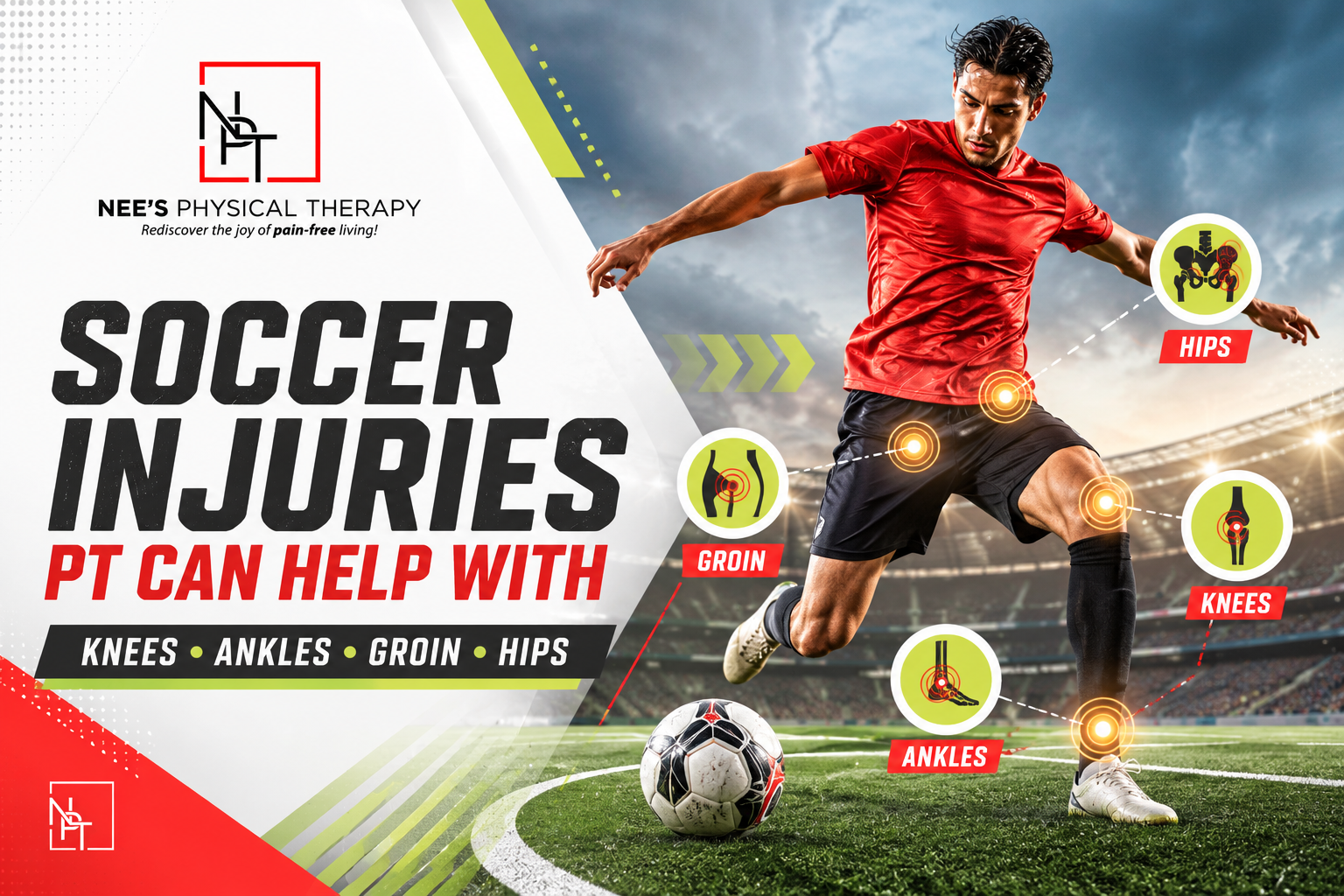
Soccer Injuries Physical Therapy Can Help With: Knees, Ankles, Groin, and Hips
Soccer has a way of pulling you in. One minute you are playing a casual weekend game, and the next you are sprinting harder than you planned, cutting faster than your body expected, and chasing one more goal even though your knee, ankle, groin, or hip has started talking to you.
And with the 2026 FIFA World Cup bringing so much energy to New Jersey, soccer feels even more alive right now. Local fields, adult leagues, school teams, pickup games, and weekend tournaments all have that extra buzz. It is exciting, but it also means more players are playing more often, training harder, and brushing off small aches because they do not want to miss out.
If you are a soccer player and something has started to hurt, your first thought may be, “Can I keep playing?” That is a fair question. Soccer is not easy to step away from. But pain that keeps returning, changes how you move, or makes you hesitate on the field deserves a closer look.
A soccer injury physical therapy plan can help you understand what your body is struggling with, what needs to improve, and how to return to play with more confidence.
Soccer Injuries Physical Therapy Can Help With: Knees, Ankles, Groin, and Hips
Soccer has a way of pulling you in. One minute you are playing a casual weekend game, and the next you are sprinting harder than you planned, cutting faster than your body expected, and chasing one more goal even though your knee, ankle, groin, or hip has started talking to you.
And with the 2026 FIFA World Cup bringing so much energy to New Jersey, soccer feels even more alive right now. Local fields, adult leagues, school teams, pickup games, and weekend tournaments all have that extra buzz. It is exciting, but it also means more players are playing more often, training harder, and brushing off small aches because they do not want to miss out.
If you are a soccer player and something has started to hurt, your first thought may be, “Can I keep playing?” That is a fair question. Soccer is not easy to step away from. But pain that keeps returning, changes how you move, or makes you hesitate on the field deserves a closer look.
A soccer injury physical therapy plan can help you understand what your body is struggling with, what needs to improve, and how to return to play with more confidence.
Soccer injuries are often influenced by training load, strength, mobility, recovery, running mechanics, and change-of-direction control. Sports PT helps identify the limiting factor before symptoms become recurring or harder to manage.
Why Soccer Injuries Happen So Often
Soccer asks a lot from your body. You jog, sprint, stop, cut, jump, land, kick, pivot, and absorb contact. You may play at a steady pace for a few minutes, then suddenly accelerate at full speed. You may plant one foot, rotate, and kick before your body has fully prepared.
That mix is what makes soccer fun. It is also what makes the sport physically demanding.
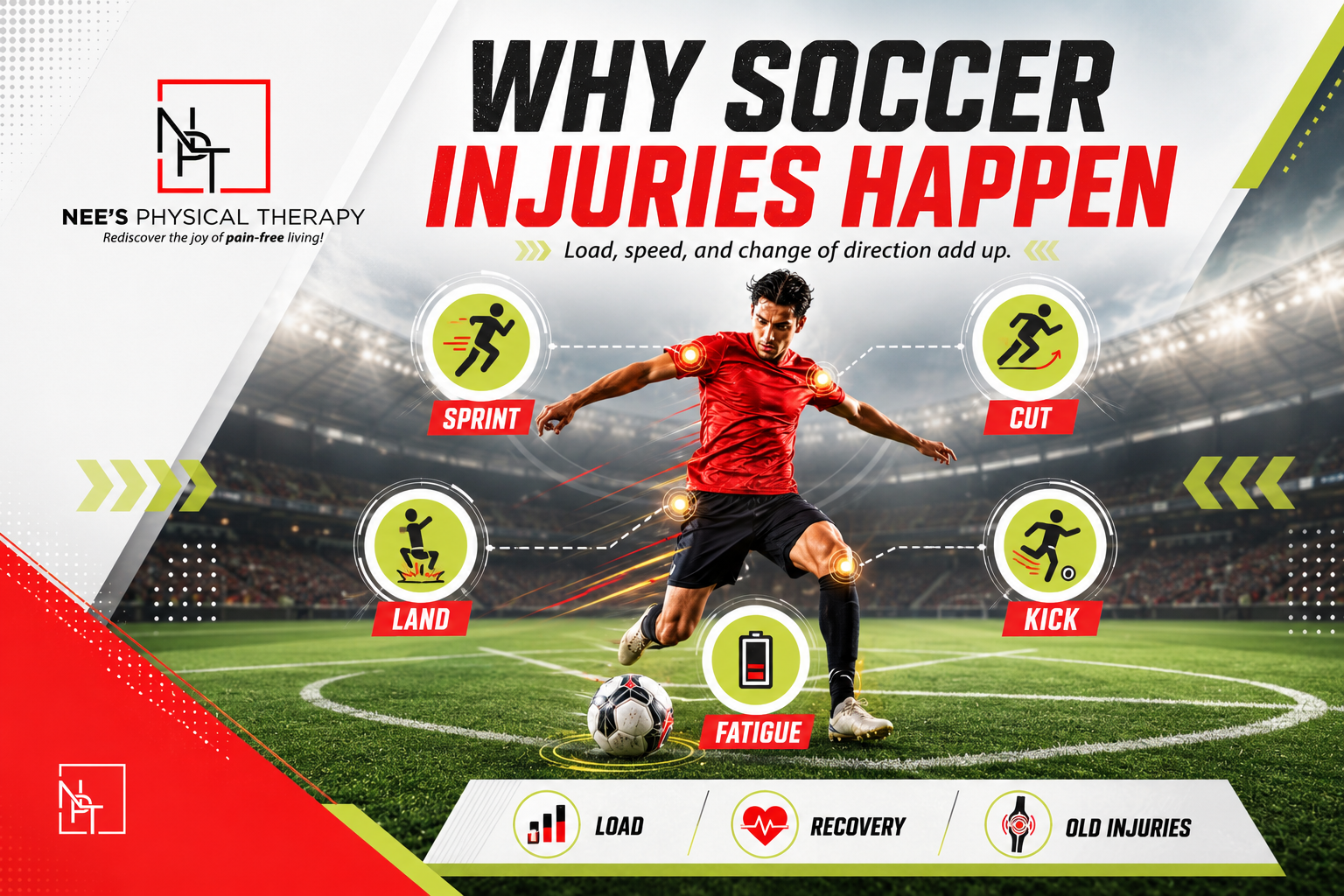
Some soccer injuries happen in one clear moment. You roll your ankle. You twist your knee. You feel a pull in your groin. Other injuries build quietly over time. A little tightness becomes soreness. Soreness becomes pain. Pain starts changing how you run, kick, or cut.
Common reasons soccer players get injured include:
A sudden increase in games or practices
Playing multiple matches in a short period
Returning too quickly after time off
Poor recovery between sessions
Weakness in the hips, glutes, calves, or core
Limited ankle or hip mobility
Repeated sprinting, cutting, or kicking
Fatigue late in a game
Old injuries that never fully recovered
Playing through pain for too long
Most players do not get injured because they are not trying hard enough. Many get injured because their bodies are doing a lot, and recovery, strength, or movement support has not yet caught up.
A Soccer Player Scenario: When a Small Injury Changes Everything
Imagine this.
You roll your ankle during a weekend game. It hurts, but you can walk. You rest for a few days, maybe ice it, maybe wrap it, and then you go back to practice because it feels “good enough.”
During warm-up, it seems fine. But when you cut sharply, the ankle feels shaky. So, without thinking, you start protecting that side. You plant differently. You push off differently. You avoid turning one way.
A few weeks later, your knee starts hurting. Then your hip feels tighter. Your sprint feels uneven. You are still playing, but your body has changed how it moves around the original injury.
This happens more often than players realize. Soccer injuries do not always stay in the area where they started. When one part of the body loses strength, mobility, or confidence, another area may take on extra work.
That is why a Sports PT assessment looks at the injury and the full movement pattern around it.
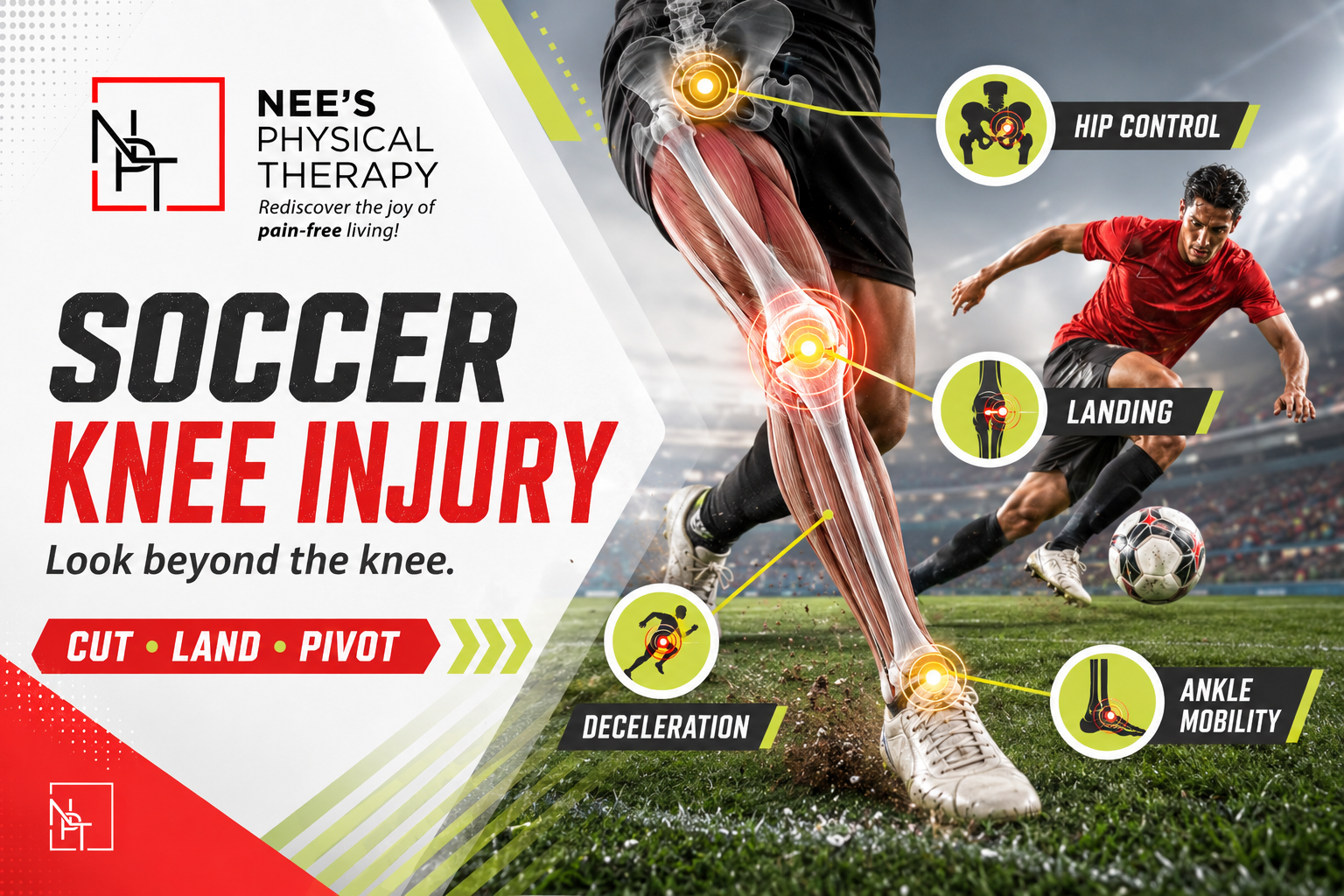
Soccer Knee Injury: Why the Hip, Ankle, and Landing Pattern Matter
A soccer knee injury can show up in different ways. You may feel pain around the kneecap, on the inside of the knee, on the outside of the knee, or deep in the joint. The pain may appear with cutting, landing, sprinting, squatting, stairs, or after a game.
Some knee injuries happen suddenly during a twist, collision, or awkward landing. Others build because the knee keeps absorbing more stress than it can tolerate.
Knee pain in soccer may be connected to:
Hip strength
Quad and hamstring control
Ankle mobility
Landing mechanics
Single-leg balance
Cutting and pivoting control
Training load
Fatigue
Previous ankle or hip injuries
For example, if your hip does not control your thigh well when you cut, your knee may take more strain. If your ankle feels stiff after an old sprain, your knee may absorb more force when you land. If you struggle to slow down after sprinting, your knee may feel irritated after repeated stops and starts.
Good rehab for a soccer knee injury should prepare you to return to the field. That means strength work, landing control, deceleration, cutting, and sport-specific movements. Feeling okay while walking daily is a start, but soccer demands much more.
Ankle Sprain: Why Soccer Players Should Take It Seriously
An ankle sprain that a soccer player experiences can seem minor at first. The swelling goes down. Walking gets easier. You start to feel normal again.
Then you return to the field and realize the ankle still does not trust quick movement.
You may feel unsure when you cut. You may hesitate when another player comes close. You may avoid planting on that side. That hesitation matters because soccer requires quick reactions.
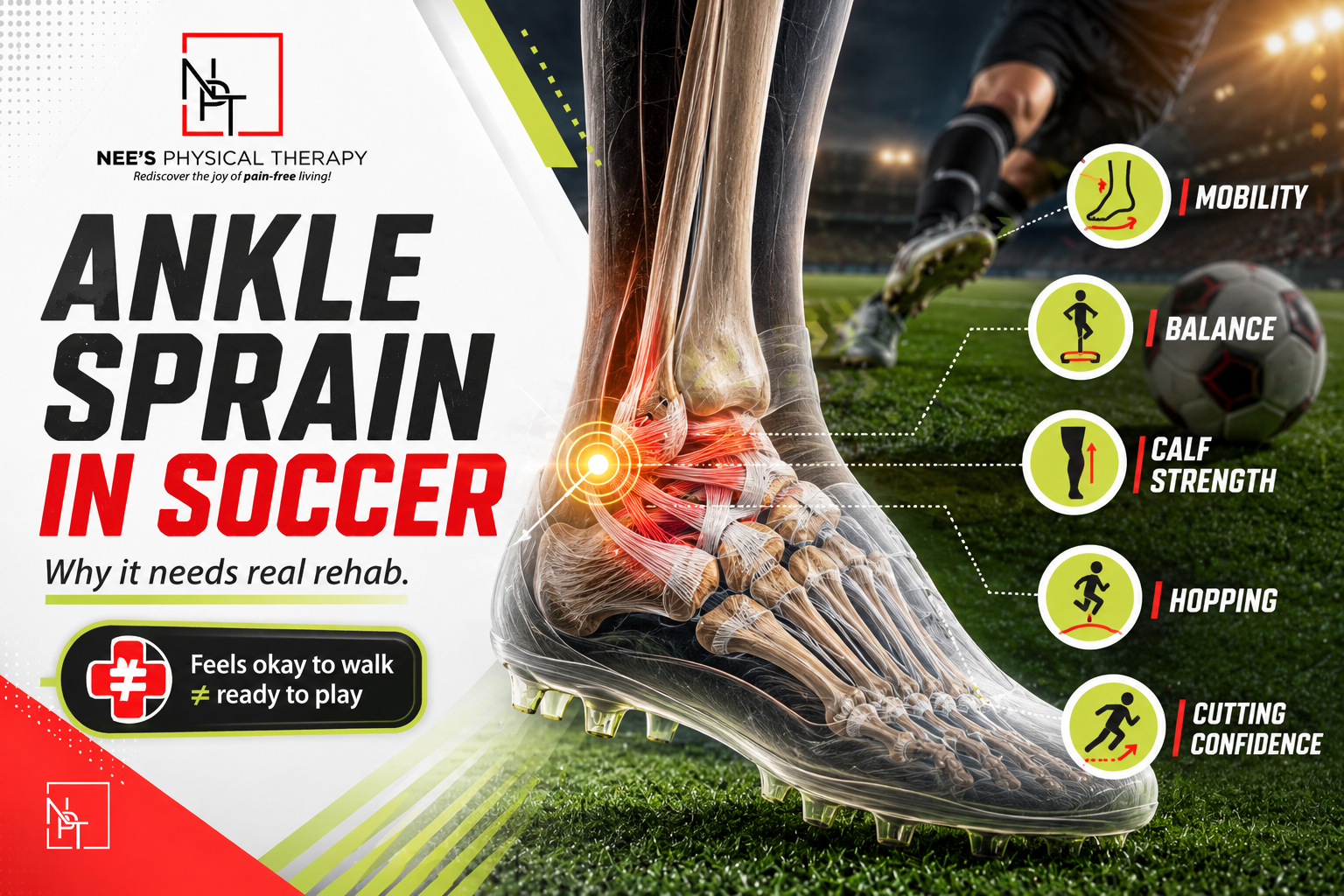
After an ankle sprain, the ankle may lose strength, balance, mobility, and proprioception. Proprioception is your body’s ability to sense where the joint is in space. In soccer, that sense matters every time you land, pivot, or react to the ball.
Signs your ankle sprain needs more rehab include:
Swelling that keeps returning
Pain with cutting or pushing off
A feeling that the ankle may give way
Difficulty balancing on one leg
Stiffness when squatting or lunging
Fear of planting the foot
Repeated ankle rolls
Proper ankle rehab may include mobility work, calf strengthening, balance drills, hopping progressions, lateral movement, and return-to-sport drills. The goal is to rebuild the ankle for soccer, not simply wait until it feels okay during regular walking.
Groin Pain: Soccer Players Should Not Keep Stretching Forever
The groin pain soccer players experience can feel confusing. It may feel tight, sharp, deep, or like a pulling sensation. You may notice it when sprinting, cutting, passing, shooting, or changing direction.
Many players respond by repeatedly stretching the groin. Sometimes that gives short-term relief. But if the pain keeps coming back, the area may need more support rather than more stretching.
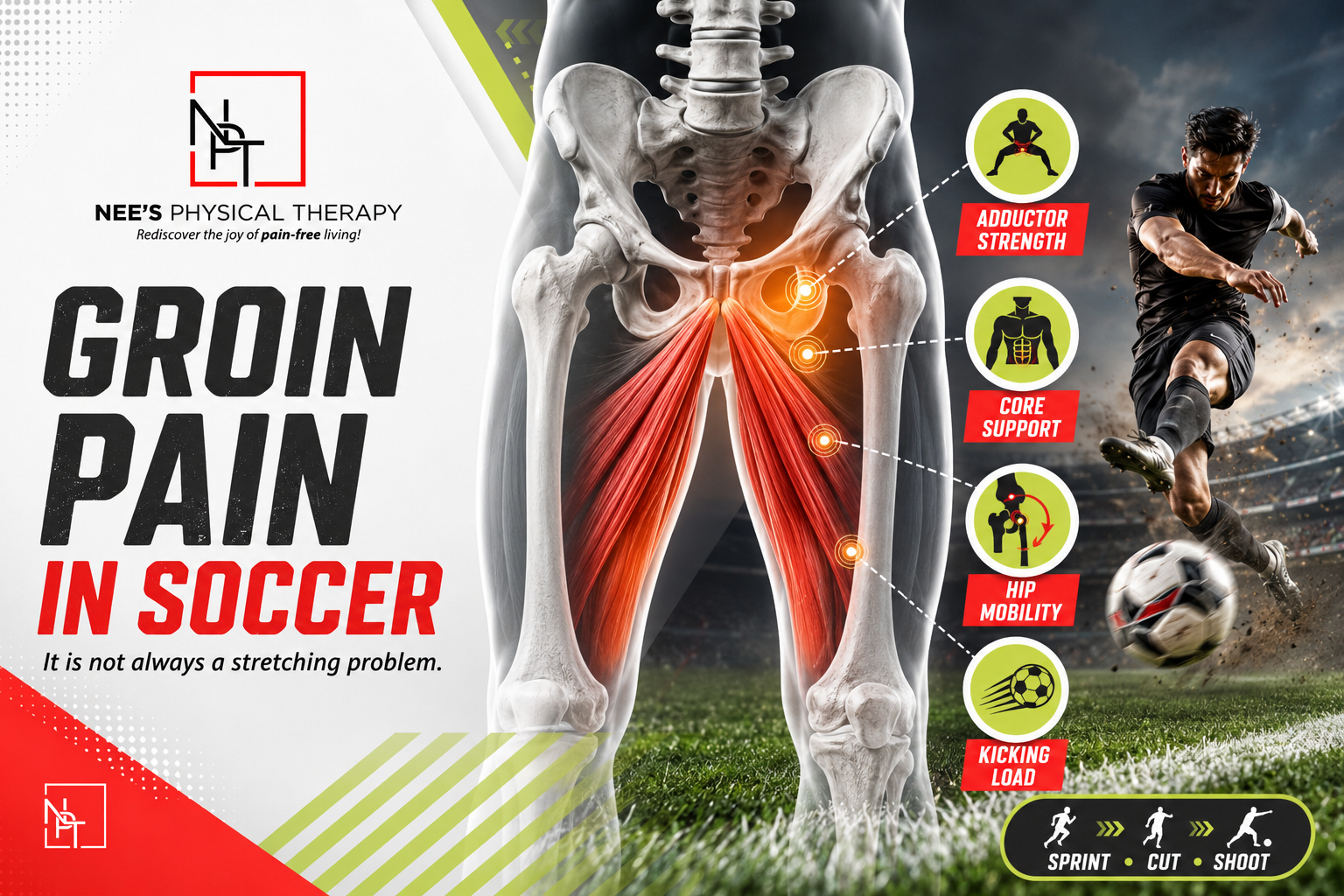
Groin pain may be connected to:
Adductor strength
Hip mobility
Core control
Pelvic stability
Kicking mechanics
Sprint load
Change-of-direction demands
Fatigue
Training volume
The groin muscles work hard in soccer. They help with kicking, sprinting, lateral movement, and controlling the leg when you change direction. If your hips and core are not giving enough support, the groin may keep taking on more work than it can handle.
A PT assessment can help figure out whether you need strengthening, mobility work, load management, core coordination, or a slower return to sprinting and kicking.
Hip Pain in Soccer Players
Hip pain can show up as pinching in the front of the hip, tightness in the hip flexors, soreness near the glutes, pain with kicking, or discomfort during lateral movement.
Your hips play a huge role in soccer. They help you sprint, rotate, kick, cut, and stabilize your body when one foot is on the ground. If your hips lack strength or mobility, your knee, groin, ankle, or lower back may start doing extra work.
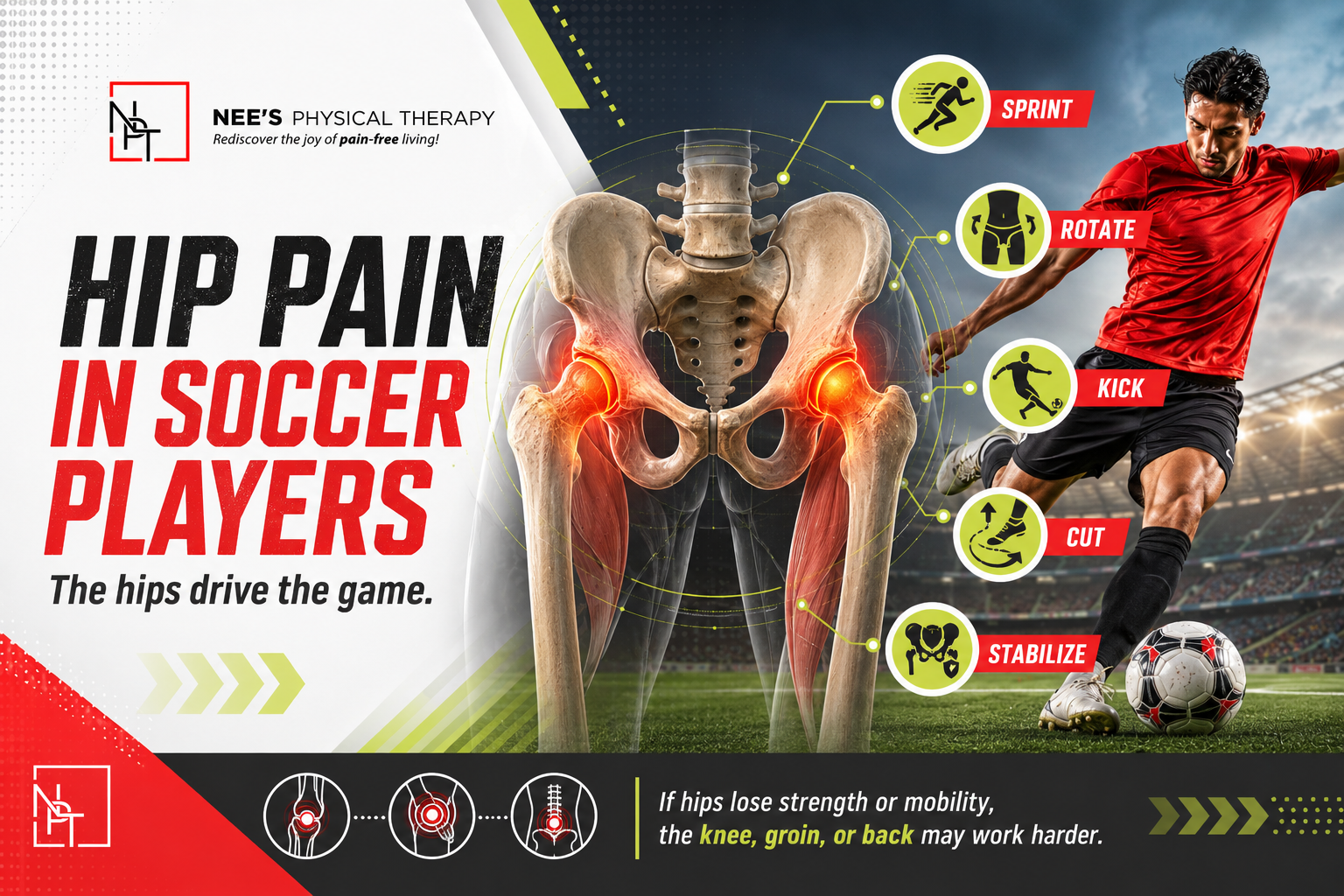
A Sports PT may assess:
Hip rotation
Glute strength
Single-leg control
Core coordination
Stride mechanics
Kicking tolerance
Lateral movement
Deceleration control
Hip rehab for soccer players should eventually move beyond basic mat exercises. The body needs to build toward the actual demands of the sport, including cutting, sprinting, kicking, and reacting under fatigue.
Can Physical Therapy Help Soccer Players Stay Active?
Yes, physical therapy can often help soccer players stay active while they recover. The plan depends on the injury, pain level, and how symptoms respond to movement.
Some players may need to stop playing temporarily. Others may be able to modify practice, reduce minutes, avoid sprinting, skip scrimmage, or focus on strength and conditioning while symptoms calm down.
A physical therapist can help you decide:
Can you keep practicing?
Should you avoid games for now?
Can you run but avoid cutting?
Can you strengthen without increasing pain?
What movements are safe right now?
What needs to improve before full return?
This is where guessing can become frustrating. If you push through pain, symptoms may get worse. If you rest without a plan, the same pain may return when you play again.
Sports PT gives you a clearer path. It helps you stay connected to the sport while respecting what your body can tolerate.
Training Load: The Piece Soccer Players Often Miss
Training load is one of the biggest factors in soccer injuries.
Your body may feel fine during a normal week, then symptoms appear when practices increase, games stack up, or you return after time off. This can happen during tryouts, preseason, tournaments, playoffs, adult league doubleheaders, or busy weeks with team practice and extra conditioning.
Load can increase through:
More practices
More games
More minutes played
More sprinting
More cutting
More shooting
More strength training
Less sleep
Less recovery
Harder surfaces
A quick return after a break
A simple training-load note: pain often appears when the body gets asked to do more before it has had time to adapt.
That does not mean you need to stop everything. It may mean reducing sprint volume, cutting drills, game minutes, or back-to-back sessions while you build strength, mobility, and control.
When Gait Analysis Can Help Soccer Players
Gait analysis can help when pain shows up with running, sprinting, or repeated impact. Soccer is not only about straight-line running, but running still plays a large role in the game. Players jog, accelerate, decelerate, recover, and sprint again throughout a match.
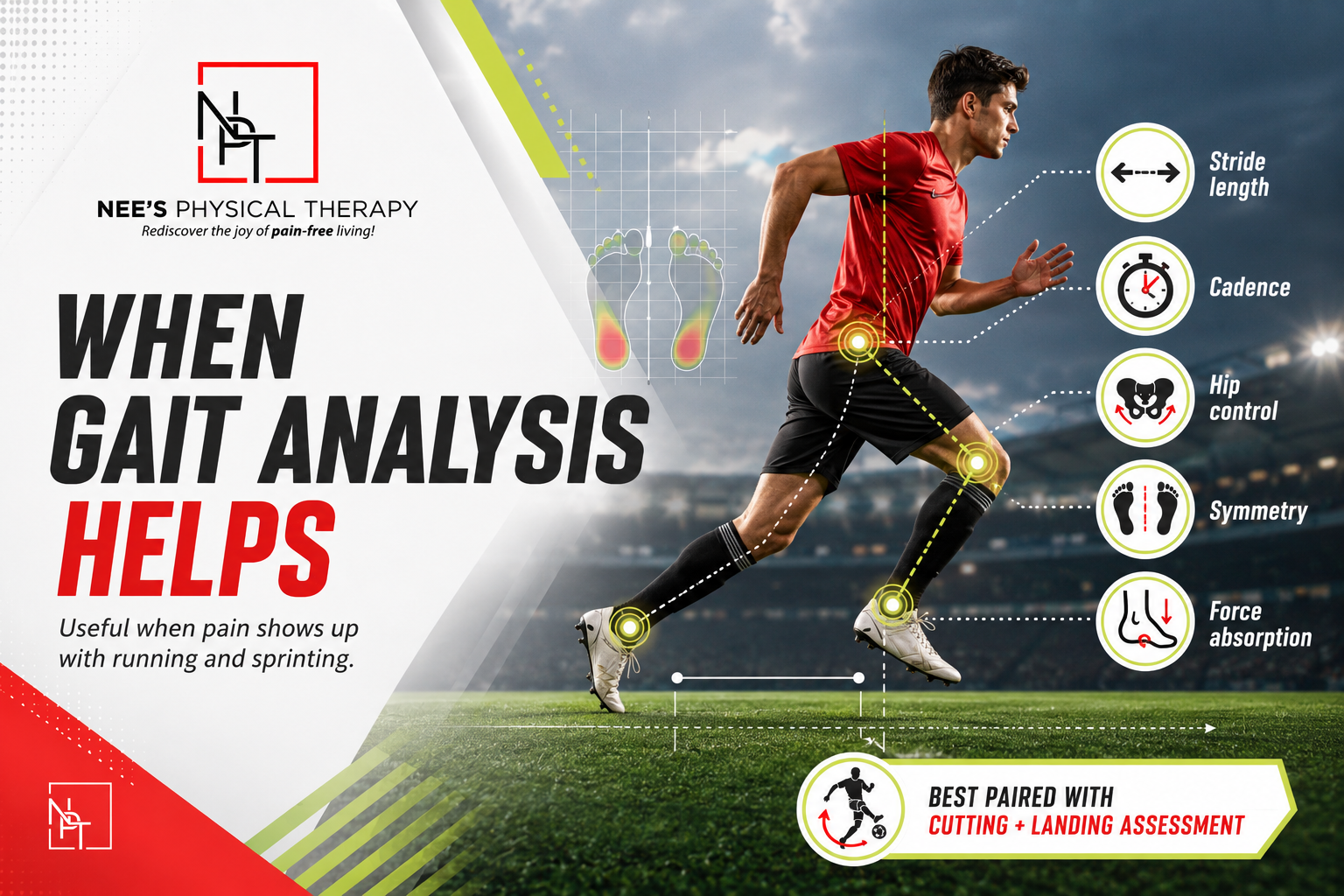
A gait analysis may look at stride length, cadence, foot strike, hip control, trunk position, symmetry, and how your body absorbs force.
It may help if:
Pain shows up during running
Symptoms return every time training increases
One side feels weaker or less controlled
You have recurring ankle, knee, hip, or groin pain
You are returning after an injury
You feel slower or less confident after the pain starts
For soccer players, gait analysis works best when paired with movement assessment. That may include cutting, landing, hopping, squatting, balance, and change-of-direction drills.
How Nee’s Physical Therapy Approaches Soccer Injuries
At Nee’s Physical Therapy in Hoboken, soccer players receive Sports PT with a 1:1 approach. Akanksha Rathod takes time to understand how the injury started, what position you play, how often you train, what movements hurt, and what you want to get back to.
A plan may include strength training, mobility work, balance drills, gait analysis, cutting mechanics, running progressions, return-to-sport testing, and training-load guidance.
The plan depends on the player. Someone recovering from an ankle sprain may need balance, hopping, and cutting progressions. Someone with groin pain may need adductor strengthening and kicking progressions. Someone with knee pain may need hip control, landing work, and deceleration training.
“With soccer players, we have to look at the sport’s real demands. Running in a straight line is one piece, but cutting, landing, kicking, decelerating, and fatigue all affect how the body handles load.” - Akanksha Rathod, Nee’s Physical Therapy
What Recovery Should Include
Recovery from a soccer injury should match the demands of the sport. You may begin with pain control and mobility, but the plan should eventually prepare you for the field.
A rehab plan may include:
Pain and swelling management
Mobility work
Strength training
Balance and proprioception
Core and hip control
Running progressions
Change-of-direction drills
Landing mechanics
Sprint preparation
Return-to-play testing
Training load guidance
The later stages matter. Many players feel fine in daily life and return too soon. Then the pain comes back during a game because the body was not ready for speed, contact, fatigue, and unpredictable movement.
When Should You See a Sports PT?
You should consider seeing a Sports PT if pain keeps returning, gets worse, changes how you move, or makes you hesitant during play.
It is especially helpful to get assessed if:
You keep rolling the same ankle
Knee pain appears during cutting or landing
Groin pain returns with sprinting or kicking
Hip pain limits your stride or power
Pain lasts after practice or games
You are changing how you run or play
You are returning after an injury and feel unsure
You do not need to wait until you can no longer play. Early assessment can help stop a small issue from becoming a long-term pattern.
A Smarter Way to Return to the Field
Soccer injuries can feel frustrating because the game matters. You may have a season, a team, a tournament, or a weekly routine you do not want to lose.
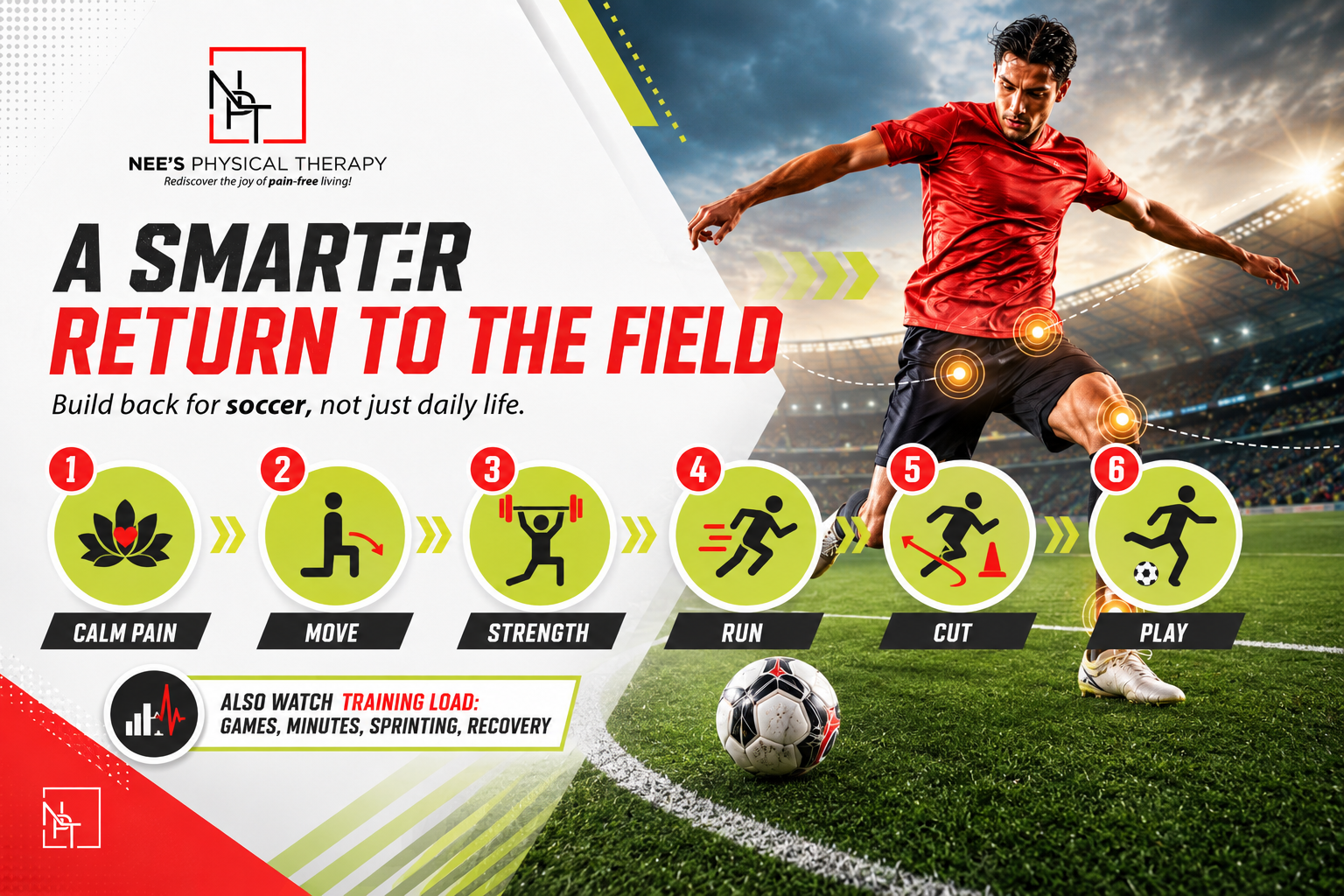
Soccer injury physical therapy helps you understand what your body needs so you are not stuck choosing between pushing through pain and resting without direction. With the right assessment, strength work, mobility, recovery guidance, and sport-specific progressions, you can build a clearer path back to the field.
Medical disclaimer: This content is for educational purposes only and does not replace medical advice, diagnosis, or treatment. Soccer injuries can vary in severity. Please consult a qualified healthcare professional for guidance based on your individual symptoms.
FAQ
Can I keep playing soccer with this pain?
It depends on how the pain behaves. If symptoms stay mild, do not change your movement, and settle quickly after activity, you may be able to continue with modifications. That may mean reducing minutes, avoiding sprinting, skipping scrimmage, or limiting cutting drills.
If the pain feels sharp, worsens, causes swelling, changes your movement, or makes you feel unstable, stop playing and get assessed.
What should I stop doing first?
Start by reducing the highest-load movements: sprinting, cutting, hard shooting, jumping, and full-speed scrimmage. These places put more demand on the knees, ankles, hips, and groin.
You may still be able to do strength work, mobility, conditioning, or modified drills depending on your symptoms. A PT can help you decide what to pause and what to keep.
When should I get a gait analysis?
Consider a gait analysis if pain occurs while running, returns with increased training, affects one side more than the other, or changes your stride. For soccer players, gait analysis works best when combined with movement assessment for cutting, landing, balance, and change-of-direction control.
